
“Don’t look up! look around.”
Top performing enterprises rely on Ecosystem partners to accelerate growth.
when trust boost ROI
Where well known companies rely heavily on their partner(s) to drive business growth – for example Microsoft claiming more than 500,000 – Others, like Hubspot, rely so much on them, that it may deserve a case in MBA classes.
Presumably, Hubspot could generate 6 times their organic revenue through a unique partner constellation. source
Only that.
Every company is invited to consider partnership channels as a growth engine. Partners serve as multiplicator, source of revenue and this is facilitated because Partners bring trust. The conclusion comes short: trust drives ROI.
Who would claim ROI is a secondary matter?
Mapping an ecosystem
What is a partner ecosystem? A definition was proposed by a the pope of partners, and used in several context including by Autum Grimm, Chief Revenue officer, PartnerTap
“A partner ecosystem is a network of interdependent relationships among multiple organizations, individuals, and resources, all working together to create value for their customers and drive innovation.”
Where shall you start? – It all starts with investigating where your audience needs lie in their user and professional journey. When your product or service is being used, it’s always part of a chain or a larger context. In a BtoC content, putting yourself in your customer’s shoes, you will start questioning what he is immediately doing before or after. Where he is using it, at what time of the day, etc. That’s where you could start mapping other companies serving this same audience. What do these companies know ? How much does it confirm your own customer knowledge? in a BtoB environment, you will start mapping the broader context of other services your prospects need to be successful or typical media they consider, support they need, etc. Many dimensions are to be investigated: public institutions, private companies having a reputation, banks, private companies, all sharing your audience.
In our case, we’d look at any entrepreneur or project leader going digital. Going digital is not an end, it is a means to success. Every entrepreneur has a larger plan than just going digital. Once we started mapping this larger plan, we identified a long list of more than few 100s who are the next prospective partners…
Why ecosystem partners
Trust. credibility
We still live in a world where people trust people. When one becomes a customer of a solid reputation brand, this brand can enact as a referral. Concretely, if a brand pushes another brand in their customer journey so that their own customer makes the right step or a faster step in their journey, trust is at the center of this mechanic. This can quickly result in a win-win-win. The first brand is recognized as helpful and the customer is happy, so he shall stay longer which drives lifetime higher. The customer feels at home, being listened to and understood by his service provider. The second brand fully benefits from welcoming a new customer satisfied with the first brand and being highly satisfied because they were told to trust the new brands. The second brand delivers fitting service. The virtuous circle is spinning. The trust mechanics start playing in full.
Customer Success
Obviously, these partnerships are centered on customers. What will be valuable for a customer to support him in his bigger journey? Once both brands can visualize this and make it smooth and easy to figure out for the user (the new customer). The outcome is striking: time saved, money saved, etc. these are the most powerful triggers to drive customer satisfaction.
Your audience knowledge
How damn can you build this? Some companies have achieved immense growth thanks to these initiatives. This was probably not achieved in a month or two and very unlikely at the first trial. Not only it takes time to test, but to structure, to discuss options after reviewing respective customer knowledge. What I mean here by customer knowledge, is behavioral, statistical group, audience needs and pains, hence key dimensions of buying personas.
Once both companies align on their mutual customer understanding, they take the chance to shape the best way to partner and create value for their “shared-customer”.
Sharing and learning from experience
If one partner has had a longer experience in developing winning partnerships, they can help save a lot of time in building the first meaningful trials, hence avoiding the pitfall of broken customer journey, inappropriate wording or claim or weak offer that will not catch reader’s attention from the first glimpse, etc.
Then, since the process is iterative, you need to be prepared with a digital marketer mindset: tracking, close monitoring, rapid adjusting. Repeat until it works. and that means proper transparency between the two partners so that data can be shared back and forth to serve the purpose of the partnership end-goal. Mutual NDA is the starting point.
tip: focus on gaining a first partner with active partnerships.
Deep Integration or disillusionment
too good to be true ?
- 58% Conversion lead to sales
- 20% net Conversion over the phone for high-value service
Definitely striking. disclaimer: #deep integration
We can proudly report these metrics that have been constantly achieved with one of our first ecosystem partners where we share a common audience, the SMB group made of craftsmen, small and very small enterprise, consultants and freelancers. It took us 6 months to achieve these amazing KPIs. Only with trust that was established in the first place, the conversation led to exploring multiple options and IONOS was integrated in the customer journey of our new customer’s partner. Just after payment.
Less but better leads
The right questions at the right time with a laser focus offer was key to success. The rest is execution details, and fine tuning like in any marketing activities. This has meanwhile become the new model for any new ecosystem partnership @IONOS.
Beyond ROI, the beauty of the deep integration resides in the IONOS brand being positioned as a trusted partner in front of a highly qualified audience that may need our products or services at time of exposure or… later. Later is nothing else than a perfect brand awareness initiative, certainly difficult to measure, but with the cheapest cpm ever achieved. It’s free. especially if reciprocity comes into place.
Reciprocity
Partnership health means reciprocity. Reciprocity can take several forms and is subject to each partner’s goals. There are times where companies focus on revenue or customer acquisition. Sure, most of the time both, but the partnership development shall be built on serving the partner’s focused goal. Because it fits the specific strategy of each company it’s fully supported by leadership and can help activate other services on both sides.
After describing the benefit of this partnership on the IONOS side, it is important to describe the various initiatives that took place: deep integration on our new customer acquisition before the cart. And we all know that offering a touchpoint before the cart is a significant risk… or in fact it’s not. It’s not because both partners agreed and trusted themselves. If both co-create value, integrating a partner at the right stage of a customer journey – or visitor journey in that case – is the right thing to do. What if it could also increase the early conversion? because the ultimate intent is to ensure value perception by your customer. If done properly, early partner integration reinforces trust and happiness will turn into lifetime value growth.
More as next stage
Once ROI is achieved, both partners have the choice to keep investing in the partnership and bringing new ideas to the table or being short term driven, replicating the same with a competitor for a few bucks more per leads or customers. As said, this is short term. Would former customers understand it? would they still believe the original story, how reliable can a new partner come to displace the previous one with a very similar offer? isn’t it a bigger risk to stagnate and use resources to achieve same or minor improvements ? a risk of missing the next bigger opportunity? Yes, partnership must live and evolve.
That usually results in looking beyond improving the existing and rather looking at new funnels or even co-creation. Here lies the bigger opportunity.
This happened to us when our partner, understanding our product offering, came to us and proposed to open a new funnel which we didn’t identify previously.
That is the milestones reflecting partnership maturity.
thank you
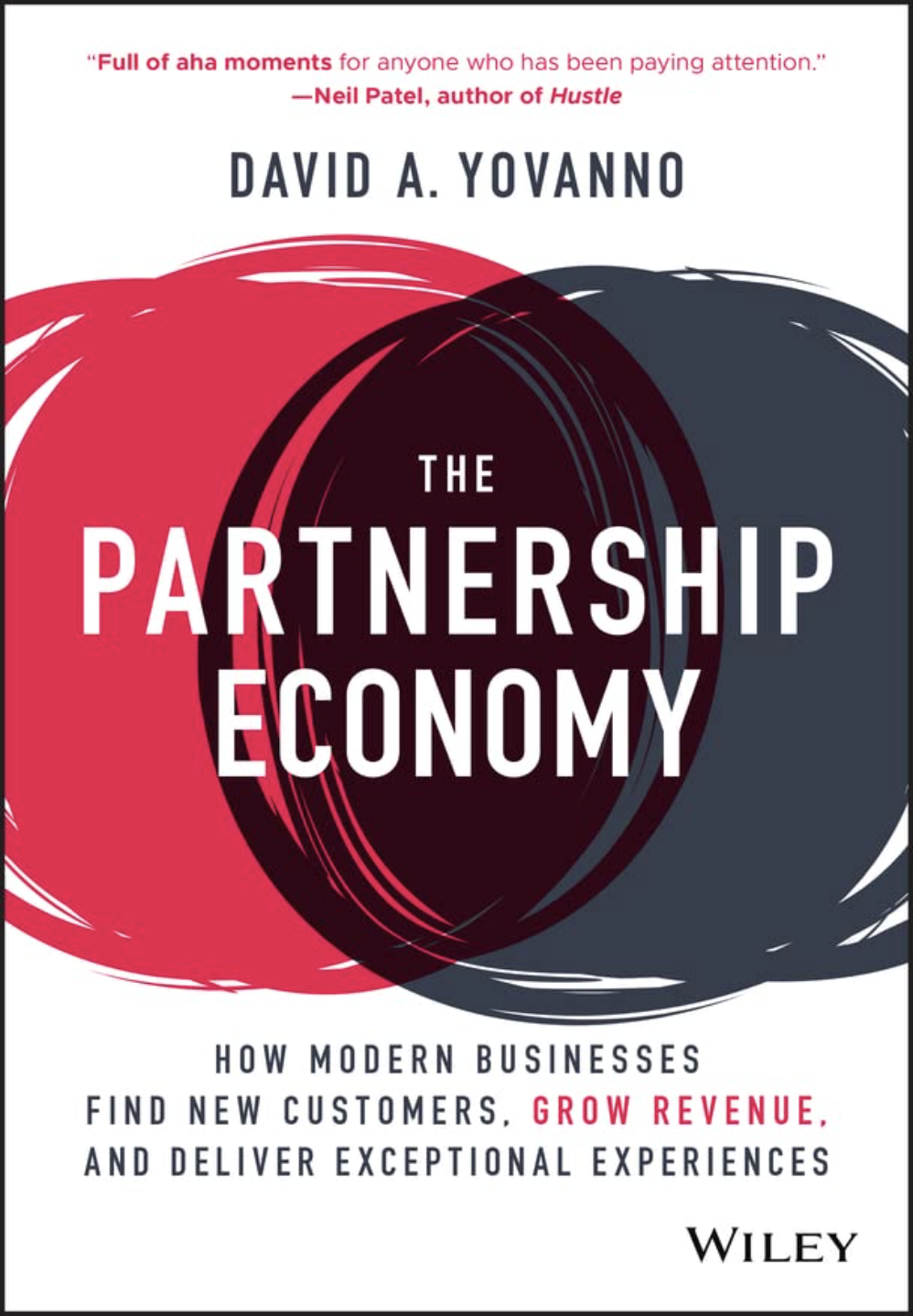
What a book! I’d like to thanks David A. Yovanno for his fantastic book: “The Partnership Economy.“
This book helped us to gain focus in our conversation and be fast in implementing what we identified earlier as a proper route to engage with.
I can only recommend it
This article could have been generated or optimized with the genAI savvy hands. Maybe next time.
Leave a Reply